Italiano
Il giardino teatro XVII-XVIII SECOLO Storico giardino Garzoni
Il giardino Garzoni, costruito tra la seconda metà del XVII e la fine del XVIII, si qualifica per la posizione autonoma rispetto alla Villa che si erge sulla collina, come avamposto del borgo di Collodi.
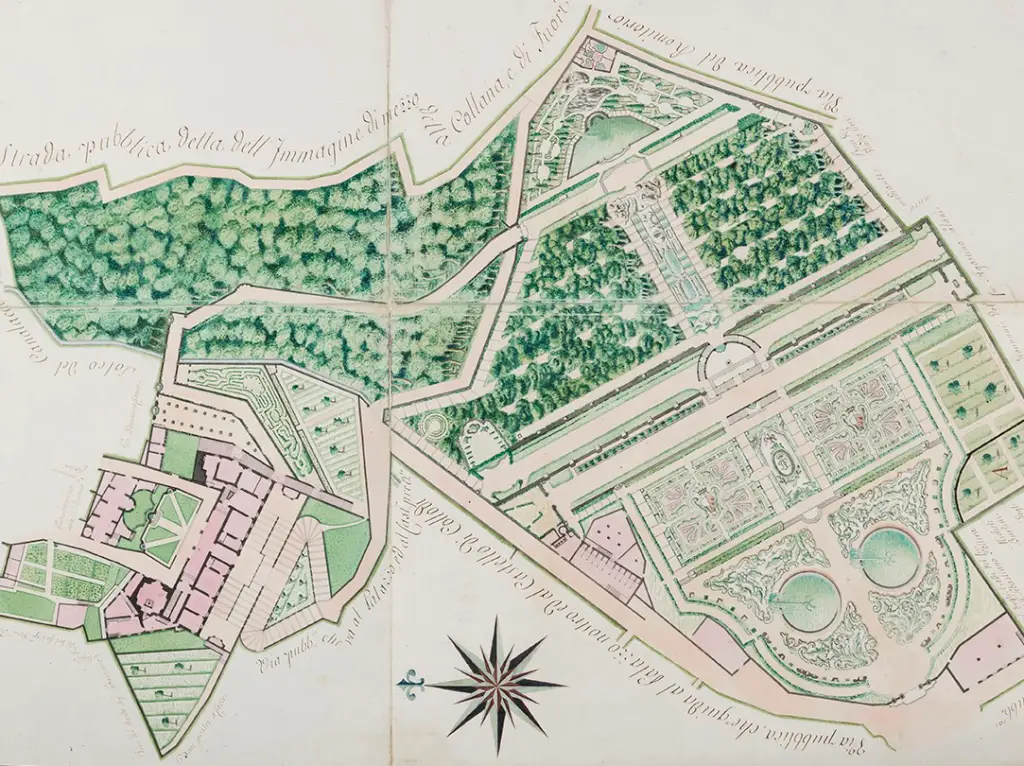
Villa e Giardino sono collegati da un sistema di visuali, ideate da Muzio Oddi (Urbino, 1569 – Urbino, 1639), ingegnere militare, esperto di gnomonica e topografia, autore di trattati sullo Squadro e sugli orologi solari. Alla fine del Seicento il giardino presenta un impianto strutturato come una grande scenografia, con un asse centrale culminante con un romitorio, gli assi trasversali che attraversano il bosco, una platea a campana, terrazzamenti per la coltivazione di agrumi, il labirinto e un orto nell’area più vicina alla villa; mentre un giardino di fiori, si trova tra le mura che circondano il palazzo della villa.
Questo impianto rafforza la sua vocazione teatrale nel secondo Settecento, ma già ai primi del secolo Filippo Juvarra (Messina, 1678 – Madrid, 1736) propone un fondale scenico per il palazzo (poi palazzina d’estate o dell’orologio) e alcuni disegni di fontane che attestano un più ampio coinvolgimento nei lavori. La metamorfosi del giardino in una complessa macchina teatrale, si deve a Ottaviano Diodati (Lucca, 1716 – Lucca, 1786), autore di commedie, progettista di teatri (teatro Castiglioncelli di Lucca e di Grodno in Polonia), curatore della riedizione dell’Encyclopédie di Diderot d’Alembert, “bizzarro ingegno”. Egli seppe trasformare l’insieme di vegetazione, acqua, roccia, in una grandiosa scenografia culminante con un padiglione per i bagni, che imprime alla scena un carattere laico, in linea con il gusto barocco delle turcherie. Questo processo di teatralizzazione nella natura è documentato dal confronto tra il “terrilogio” del 1680 con quello del 1797 che mostra la platea in forma di “campana”, diffusa nei teatri barocchi, sulla quale si affaccia la scena centrale del teatro d’acqua e di verzura. Gli stessi parterres de broderie che disegnano il piano d’ingresso sono quadri da ammirare dall’alto della scena. Nel grande teatro-giardino s’inseriscono più episodi teatrali, come il teatro d’acqua al centro della scena inquadrata dai due Satiri e il teatro di verzura ai margini del viale del Porcellino.
English
The garden theater 17th-18th CENTURY Historic Garzoni Garden
The Garzoni Garden, built between the second half of the 17th and the end of the 18th century, qualifies for a position independent of the Villa, which stands on the hillside as an outpost of the village of Collodi.
The Villa and Garden are connected by a system of views, devised by Muzio Oddi (Urbino, 1569 – Urbino, 1639), a military engineer, expert in gnomonics and topography, and author of treatises on the Squadron and sundials. At the end of the seventeenth century, the garden presents a layout structured like a large stage set, with a central axis culminating in a hermitage, the transverse axes running through the woods, a bell-shaped stalls, terraces for the cultivation of citrus trees, the labyrinth and a vegetable garden in the area closest to the villa; while a flower garden, is located between the walls surrounding the villa’s palace.
This layout strengthened its theatrical vocation in the second half of the 18th century, but already in the early part of the century Filippo Juvarra (Messina, 1678 – Madrid, 1736) proposed a scenic backdrop for the palace (later the Palazzina d’estate or clock building) and some fountain designs that attest to a broader involvement in the work. The metamorphosis of the garden into a complex theatrical machine is due to Ottaviano Diodati (Lucca, 1716 – Lucca, 1786), author of plays, designer of theaters (Castiglioncelli theater in Lucca and Grodno theater in Poland), editor of the re-edition of Diderot d’Alembert’s Encyclopédie, “bizarre ingenuity”. He was able to transform the whole of vegetation, water, rock, into a grandiose stage setting culminating in a bathing pavilion, which imparts a secular character to the scene, in keeping with the Baroque taste of the Turks. This process of theatricalization in nature is documented by comparing the “terrilogy” of 1680 with that of 1797, which shows the stalls in the form of a “bell,” common in Baroque theaters, onto which the central scene of the water and greenery theater faces. The same parterres de broderie that design the entrance stalls are paintings to be admired from above the stage. More theatrical episodes fit into the large theater-garden, such as the water theater in the center of the scene framed by the two Satyrs and the verzura theater at the edge of the Viale del Porcellino.